
Events & Registration
Upcoming alliance courses and events. Dates follow the source announcements; registration may close early when seats fill.

Types of events
The events area covers briefings, large forums and networking events, as well as professional course series run with the alliances.
In September and October 2026 the Academy held two series from the Semiconductor Cybersecurity Academy: enterprise blue team defense, and a red-to-blue Purple Team Threat Hunting practicum.
Upcoming sessions
- Startup Week: Connecting the Taipei Startup Cities (27 events and courses)
- [N-Generation Academy Industry Club] Role Model Company Visit: Growth Strategies for Steady Business Scale-Up
- AI-Automated E-commerce | Hands-on Japan Proxy Buying Course for Beginners
- Talent Meet Startup Gathering Series: Digging into Real User Needs to Find AI Topics and Solutions
- N-Generation Academy Graduation Ceremony
- [2026 I Am a Founder] EP4 When Sci-Fi Becomes Everyday Life
- Taiwan Startup Incubation Industry Association Annual Conference
- Investing in a New Landscape: Driving Investment Strategies from Industry Opportunities
- Tech Startup Program - Financial Forecasting for Startups: From Operating Assumptions to Building a Financial Model
- Hands-on AI Website Building: Quickly Create Your Brand Website from Scratch
- Essential Course for Going Global in the AI Search Era: SEO × GEO Basics, So North American Buyers and AI Can Find You
- Startup Alliance NEXT | Startup Growth Matchmaking Party
- New Financing Environment, New Patent Opportunities: Exchange Forum
- SME Finance and Accounting Lecture Hall: How to Apply for Subsidies? How to Use Investment Tax Credits?
- Startup Topic Talk and Joint Consultation Session
- Workplace AI Toolbox: Choose the Right Tool and Get Daily Work Done
- AI Automated Workflows: Let Repetitive Work Run by Itself
- [Featured Dialogue] IP Decoded | Experts Break It Down! - Trademarks
- Tech Startup Program: Mentored Companies' Pitch and Results Showcase
- Startup Launch Bootcamp | Validate the Market with AI and Reach Your First Customers
- [Featured Dialogue] IP Decoded | Experts Break It Down! - Patents
- [Semiconductor Cybersecurity Academy] The Semiconductor Threat Landscape and OT Production-Line Defense in Fabs
- [Semiconductor Cybersecurity Academy] GenAI x ML Dual-Track: One-Day Hands-On Workshop on Blue Team Log Analysis and Threat Detection
- From Red to Blue: Attack-Chain-Driven Purple Team Threat Hunting (session 1)
- Enterprise Blue Team Monitoring and Threat Detection
- From Red to Blue: Attack-Chain-Driven Purple Team Threat Hunting (session 2)
Semiconductor Cybersecurity Academy, Sep–Oct

Enterprise blue team defense
Two parts: defense foundations and system hardening (22 Sep, completed), then monitoring and threat detection (29 Oct). Covers CIS Benchmarks, vulnerability management, SOC/SIEM, EDR/NDR and MITRE ATT&CK.
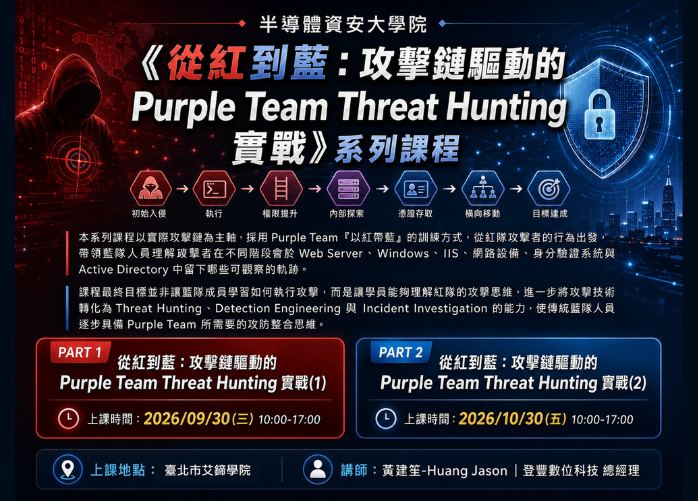
From Red to Blue: Purple Team Threat Hunting
One continuous attack scenario, from web intrusion to Active Directory compromise, turned into blue team hunting, detection and investigation skills. Sessions on 30 Sep and 30 Oct.
Registration and eligibility
Pick a session
Each session runs 10:00–17:00: six hours including a one-hour lunch break.
Register before the deadline
Register by each session's deadline; registration closes early when seats fill.
What this section covers
Events and Registration is the entry point to events run by the National Innovation and Entrepreneurship Association, R.O.C. (the Association) and the four industry alliances of Taiwan Industrial Network of Alliances for Investment (TINAI). Companies, founders and investors can see which kinds of event exist, who each suits, how to register, and which have already been held.
This page explains event types and how to take part. It does not list dates, because organisers update them. For current sessions see the list above and the events calendar; Startup Week has its own page. Held sessions are kept under Past Program Outcomes.
Events have different organisers: the Association, government agencies, incubators and the alliances. Fees, seat limits and eligibility therefore differ between events, and the terms on each event's own page apply. Where a page and this overview differ, follow the page.
Event types and who they suit
Forums and conferences centre on a topic and usually admit a wider audience. A graduation event for an SME succession and AI programme is meant for its trainees. A demo day showing results from corporate and start-up collaboration invites benchmark companies, start-ups, government bodies and venture investors. Read the audience line first, so that you do not arrive at the wrong room. Sizes vary from small round tables to rooms of a couple of hundred people, and the stated size tells you how much access to speakers to expect.
Courses and talks train skills and usually have a seat limit; some are online only. Some automotive components courses, for example, are open to members of the Automotive Components Alliance and others with an interest in the topic. Online talks for SMEs also run. Courses suit people who will bring the skill back to their company, so send the person who owns that work. A manager who will not use the skill is a poor choice, however senior.
Exhibitions, networking and matching events are for contact. Exhibition areas let firms show products and solutions, and some are open to visitors. Networking and matching events are small round tables or pairings with a clear audience, such as AI start-ups and start-up mentors. Briefings explain alliances and programmes and how to apply. For overseas readers, the useful distinction is between events for learning, which suit staff, and events for contact, which suit decision-makers.
How registration works
Most sessions carry a registration link. Some point to the organiser's own event page, where you fill in a form; others point to a course page of the Association. A few events ask you to call, and exhibition areas may be open to walk-in visitors with no prior registration. Each event page states its own method. If a page gives only a telephone route, note it and call during office hours.
Registration normally asks for a name, work email, organisation and job title, and some events ask about your purpose. Use a work address you can read, because the confirmation email decides whether a place is held. For the Semiconductor Cybersecurity Academy courses, the organiser states that the confirmation email governs.
Deadlines vary. Courses often close a few days before the first class, and earlier if seats fill. Register early once you have checked the audience and time. Courses with a stated cap, such as fifteen, twenty or thirty places, fill sooner than open forums. If you cannot attend after registering, tell the organiser so that the place can go to another company.
A worked example: Semiconductor Cybersecurity Academy courses
In September and October 2026 the Semiconductor Cybersecurity Academy ran two series that show how a course event is set up. Enterprise Blue Team Defence had two days, one on system hardening and vulnerability management and one on security monitoring and threat detection. From Red to Blue: Purple Team Threat Hunting had two sessions that follow one continuous attack, from web intrusion to Active Directory compromise, to train hunting and investigation.
Each session ran from 10:00 to 17:00, six hours including a one-hour lunch break, in a computer lab in Zhongzheng District, Taipei. Attendance was free, with a provisional limit of two people per company. The organiser asked firms to send suitable staff for each topic, such as security, SOC, IT operations and vulnerability management staff.
The full outlines and held sessions are on the blue team course page and the Purple Team course page. Both series have been held; the pages remain as a reference for course design and registration terms.
Before you attend, and how to follow up
Do three things first. Check that the audience includes your organisation. Check the time and the place or online format. Check the fee and seat terms. When a company sends staff to a course, agree beforehand what you expect them to bring back, and ask them to share it afterwards, so that one person's learning becomes a team asset.
The free attendance and the two-person limit apply only to the two Semiconductor Cybersecurity Academy series. Fees, seats and eligibility for other event types are not set in one place here; see each event page or ask the Association.
If you represent a company and want to know whether alliance events fit your needs, or would like an organiser to arrange a session on a given topic, use the contact page. State your organisation, your need and what you hope to gain, and the Association will refer you to a suitable alliance or organiser.
Frequently asked questions
Do events cost anything?
It depends. The two Semiconductor Cybersecurity Academy series were free, with two places per company. For other events, follow the terms on the event page or ask the National Innovation and Entrepreneurship Association, R.O.C. (the Association).
Can overseas companies or investors attend?
Audiences differ by event, so check the audience line on the event page first. If none is stated, ask the organiser through the contact page whether overseas and online participants are accepted.
How do I know my place is confirmed?
A registration confirmation email is the test. Use a work address you can read, and check your spam folder. If you cannot attend after registering, tell the organiser early, since registration may close early when seats fill.
Where can I read about events already held?
Held events, including forums and courses, are collected under Past Program Outcomes with their dates and venues. Where talks or materials are public, the event page says so; otherwise, you can ask.


